
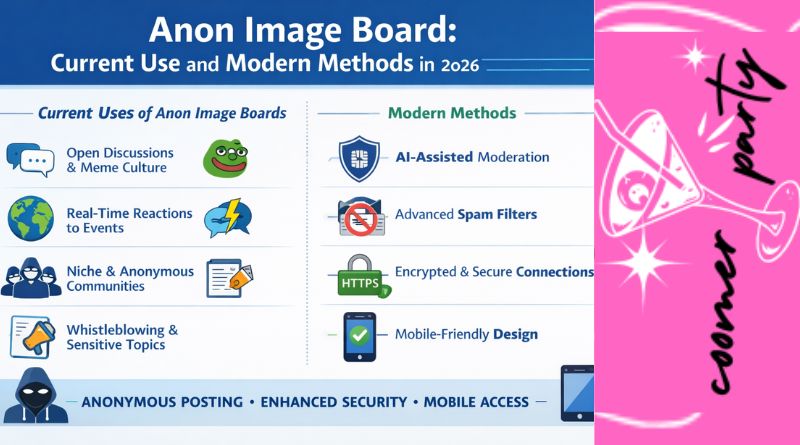
The anon image board has evolved significantly from its early 2000s origins. While it still operates on the principle of anonymous posting, its current use reflects the realities of modern internet culture—faster communication, heightened moderation debates, and growing concerns around privacy. Today, the anon image board is no longer just a chaotic corner of the web; it has adapted to changing technology and user expectations while maintaining its anonymous core.
Current Use of Anon Image Boards
In 2026, the primary use of an anon image board centers around open discussion, meme culture, niche communities, and real-time reactions to global events. Unlike identity-driven platforms, users visit these boards to share ideas without attaching their names, careers, or personal brands to their opinions. This makes them particularly attractive for candid conversations about politics, technology, gaming, and internet trends.
- Platforms such as 4chan and 8kun continue to operate as hubs for anonymous interaction, though their communities vary widely in tone and content. Meanwhile, some users migrate between anonymous spaces and mainstream forums like Reddit, comparing the structured moderation of one with the raw openness of the other.
- Today’s anon image board is also heavily integrated into meme generation. Many viral trends still originate in anonymous threads before spreading to larger platforms such as X. Because there are no identity barriers, users feel free to experiment with humor, satire, and unconventional ideas without long-term reputational risk.
- Additionally, whistleblowing and sensitive topic discussions sometimes occur on these boards due to the reduced traceability compared to traditional social networks. While not entirely untraceable, the absence of personal accounts provides a perceived layer of protection for users discussing controversial or private matters.
Modern Methods and Technological Adaptations
- The modern method of operating an anon image board has become more technically refined than its early versions. Initially, these boards were simple HTML-based forums with minimal moderation tools. Today, many boards implement advanced backend systems, including automated spam filtering, AI-assisted moderation, and CAPTCHA verification to prevent bot flooding.
- One of the biggest changes is improved content filtering. Modern anon image boards often allow users to hide specific keywords or threads, offering a customizable experience without abandoning anonymity. This balances freedom of speech with user comfort.
- Security measures have also evolved. With growing awareness of cybersecurity risks, some boards now use encrypted connections (HTTPS by default) and stronger server protections. While anonymity remains central, administrators are more conscious of legal compliance and server stability than in the past.
Another modern development is mobile optimization. Early anon image board platforms were difficult to navigate on smartphones. Today, many boards offer responsive web design or third-party apps that make browsing and posting seamless on mobile devices. This shift reflects the reality that most internet traffic now comes from smartphones rather than desktop computers.
Furthermore, moderation methods have shifted from purely reactive to semi-automated systems. Instead of relying solely on volunteer moderators, some platforms use machine learning tools to detect explicit content or coordinated spam campaigns. This represents a significant modernization while still preserving the platform’s anonymous structure.
The Role of Anonymity in Today’s Digital Climate
In a digital environment dominated by personal data tracking, algorithm profiling, and influencer culture, the anon image board provides a contrasting experience. It removes follower counts, likes, and algorithmic feeds. Threads rise and fall based on direct engagement rather than personalized recommendations.
This simplicity appeals to users who feel fatigued by curated social media environments. Instead of performing for an audience, participants engage in spontaneous, often fast-moving discussions. However, the same anonymity that encourages openness can also enable harmful behavior, which is why modern boards are investing more in technical moderation systems than ever before.
The modern anon image board is no longer just an internet relic. It has adapted technologically, culturally, and structurally to fit today’s digital ecosystem. By combining anonymity with updated security, moderation, and mobile-friendly design, it continues to serve as a unique online space—one that reflects both the freedoms and challenges of anonymous communication in 2026.